Category Archives: Featured

Rave review of Saving the Karamazovs from Enlighten Tusk Publishing

Enlighten Tusk Publishing‘s editorial team has prepared this assessment of the novel’s strengths, themes, and overall impact. They have also selected Saving the Karamazovs for representation to a film company as a potential adaptation project.


Editorial Note:
This book review was prepared by our editor, Ellen J. Ward, and completed on November 07, 2025. After careful consideration, we have selected
Saving the Karamazovs for representation to a film company.

Set against the backdrop of the 1990 Gulf War and the volatile world of high-stakes business, Saving the Karamazovs by Gary Goldstick is a powerful and deeply human family drama about loyalty, ambition, and the moral cost of success.

The story centers on three brothers—Jeff, Kevin, and Jerry Bascomb—whose personal rivalries and emotional wounds spill into the corporate battlefield when their family company faces financial collapse. Jeff, a Vietnam veteran haunted by failure, struggles to protect the people who depend on him as scandal threatens to destroy everything he’s built. His older brother, Kevin, once the steady anchor, is now a shadow of himself, battling poor health and depression. Their youngest brother, Jerry, a Wall Street prodigy, is called home to save the family business—only to fall in love with Jeff’s mistress, Helen, and ignite a chain of betrayals that could devastate them all.

Goldstick, drawing from his own 30-year career as a management consultant, writes with striking authenticity about the pressures of leadership, the fragility of ethics under stress, and the quiet desperation that often drives successful people to self-destruction. The novel’s corporate realism gives it a unique texture—readers can feel the tension in boardrooms and backrooms alike—but what truly elevates the book is its psychological and emotional depth.

Like Dostoevsky’s The Brothers Karamazov, which clearly inspires it, Saving the Karamazovs is less about business than it is about the human heart under siege. The Gulf War serves as a fitting mirror to the Bascombs’ own private war—each brother fighting for love, validation, and forgiveness in a family torn apart by pride and secrets.

Goldstick’s prose is sharp, grounded, and cinematic. His pacing balances the weight of financial intrigue with intimate character moments that linger long after the final page. At times, the story delves deep into corporate detail, which may slow the rhythm for readers more attuned to emotional drama, but it’s precisely this realism that makes the book so believable.

In the end, Saving the Karamazovs is a gripping and thought-provoking novel—part family saga, part moral thriller. It’s a story about what it means to lead, to love, and to lose everything in pursuit of redemption. Intelligent, authentic, and emotionally resonant, Gary Goldstick’s debut work of fiction stands as a testament to how personal wars can be just as destructive—and just as revealing—as the ones fought on the world stage.

Verdict:
A powerful and intelligent family drama that blends corporate realism with emotional truth. Saving the Karamazovs is as morally complex as it is deeply human—a modern story of guilt, ambition, and the fragile bonds that hold families together.

— Reviewed and endorsed by The Editorial Review Board

What is Business Fiction?

As the saying goes, “the times, they are a-changin’.” The book publishing industry is changing rapidly as manifested by: established authors self-publishing, expanding e-book titles, disappearing book stores and exploding genres.  It’s more and more difficult to dig through the clutter to find the kind of books you might want to read. Readers who prefer mysteries, westerns, military thrillers, romance, and other well established genres could find lots of help on the Internet. But, there are virtually no forums for readers who enjoy business fiction and business thrillers. Therefore, I decided to  create the Business Fiction Blog to provide readers commentary and insights about this growing genre and, occasionally, to comment about my own personal writing. Owing to my fifty years of experience as a business executive, computer entrepreneur, and business turnaround consultant, I am uniquely qualified to help the reader identify those business fiction novels that actually achieve the verisimilitude that the genre demands.

So, here we go, author-to-reader, and reader-to-reader:

Business fiction is distinguished from general fiction as follows:

  1. In a business fiction novel (or a business-thriller novel) the plot’s major conflicts are driven by business issues.
  2. The major characters in the novel are executives, managers, directors, employees, or investors in the business.

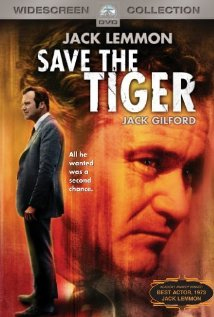
Save the Tiger (1973)Save the Tiger by Steve Shagan (the 1973 screen adaptation won Jack Lemon an Oscar) is a business novel. Harry Stoner is in the garment business. His company is failing. He hopes that the new line that is being developed will revitalize the company. However, he needs a loan to finance the new line of clothing and he is unable to find money from legitimate sources. The mob offers financing but Harry and his partner don’t like the risks. His cutter and his designer, both of whom are critical to getting out the new line, are in perpetual conflict and may resign. In order to get orders from large buyers, Harry needs to bribe them with prostitutes. One buyer has a heart attack during a sex act. Harry’s high stress causes him to see visions of his dead WWII buddies while he’s making a presentation. The Novel’s central question is:  How will Harry solve his business problems?

The Great GatsbyOn the other hand, “The Great Gatsby” by F. Scott Fitzgerald is not a Business Novel. Gatsby is newly rich and hosts lavish parties that attract glamorous people. But the conflicts in the novel arise from his attraction to Daisy, Tom’s wife, and Tom’s relationship with his mistress, Myrtle, Gatsby’s envy of Tom, and Tom’s antipathy towards Gatsby. The fact that Gatsby appears to have acquired his money illicitly is not material to the plot. Also, no one in the novel has a job. The novel’s central question:
How will the emotional and sexual relationships among Gatsby, Daisy, Tom and Myrtle be resolved?

Examples of business novels and business-thrillers are: Company Man by Joseph Finder, Sweet Talking Money by Harry Bingham, Downtick by Regan C. Ashbaugh, The Boss by Stanley Pottinger, and, of course, my novel, Saving the Karamazovs.

Risk, Hope, Hype, and the American Dream

In the financial pages of a recent New Yorker, James Surowiecki puts the spotlight on how both the con man and the entrepreneur use risk, hope, and hype to sell their project, product, or business to move your money into their pockets. But can we really compare men such as Charles Ponzi, Bernie Madoff, and Allen Stanford to Steve Jobs, Jeff Bezos, and Mark Zuckerberg?

Surowiecki traces the history of confidence men (“con men”) as revealed in the news and portrayed in entertainment (e.g., American Hustle, The Wolf of Wall Street, and The Sting), and remarks upon how Americans often admire their drive, creativity, and wits. I recall, growing up, how much I admired Robin Hood. Although he was a thief, he only robbed from those he identified as bad guys.

The thrust of Surowiecki’s article is that both the con man and the entrepreneur use the same set of tools to sell their wares: (a) the Music Man personality, (b) the prospect of potential returns that far exceed what an investment adviser can promise, (c) a risk of loss that is invariably understated and minimized, and (d) the ability to burnish the unique opportunity being offered—to hype the investment by saying things like, “Not everyone can qualify for this deal.” Finally, and most important, both types of business operators must have the ability to project conviction (“We will not fail!”) and excellent persuasion skills.

The only issue I take with Surowiecki is that he implies that there are only two categories of “businessmen” in the gene pool: confidence men and entreprenurs. The plain fact is that Bernard Madoff and Steve Jobs are at the extreme edges of a continuum. And where a particular businessperson falls along the continuum depends on two factors; the objective probability that the plan being hyped might succeed, and the extent to which the businessperson needs to rely on prevarication to make the sale.

For example, because Madoff never invested any of the money that he took from investors, the probability of his making his projections was zero; and because he had no intention of investing the money, he had to rely exclusively on prevarication to make the sale. Therefore, Madoff is 100 percent con man.

On the other hand Surowiecki’s exemplar of an entrepreneur, Steve Jobs, was able to  “convince people that improbable outcomes were not just possible, but certain.” Notwithstanding the fact that he was often too optimistic and drove his employees in directions that had low probabilities of success, he was proven right enough of the time to achieve incredible financial and reputational heights.

However, for every Madoff or Jobs, there are thousands of businesspeople who fall between the two on the continuum, and more often than not, their final position is sheer luck. An entrepreneur pursuing a very risky plan might get some lucky breaks, along with adequate financing, and succeed—falling somewhere near Steve Jobs. Another equally competent and well-intentioned entrepreneur can start out with a very realistic plan, but be unable to adequately finance it, lose key employees, skip payroll deposits in order to buy supplies, borrow on collateral that is overvalued, and is eventually get forced into  bankruptcy, at which time all of his financial transgressions become an open book; thus winding up on the Madoff side of the continuum.

Review: Ambition by Stephen Maitland-Lewis

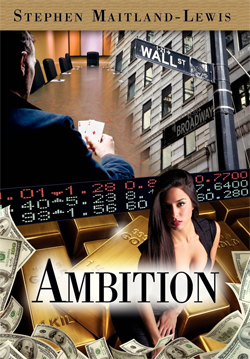
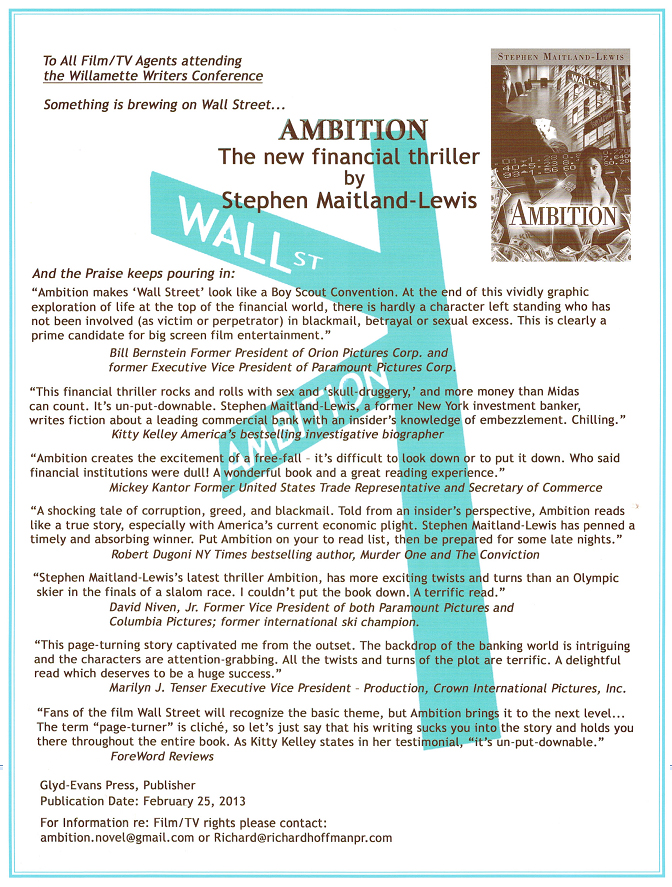
When I saw the ad in the Willamette Writers conference brochure for Stephen Maitland-Lewis’s new novel, Ambition, the lavish endorsements primed me for reading the business fiction answer to Dostoevsky’s Crime and Punishment. (Among the blurbs were ones by Kitty Kelley and Robert Dugoni – the ad appears below.) So I downloaded the Kindle version and read it over the next twenty-four hours.

Ambition by Stephen Maitland-Lewis

The story begins as a very nervous banker, George Tazoli, is attempting to withdraw $75,000 and wire $7 million from an account in a Los Angles bank, which is just around the corner from the bank where he had worked until “this morning.” We can surmise that George is probably a rogue banker who is getting ready to bolt with stolen money. The scene is just a prologue, though, and the first chapter moves us several months backwards in time.

Peter Donovan, the president of the bank, is married to an independently wealthy social climber. Their only daughter Samantha (Sam), also independently wealthy, is a sexually liberated, self-indulgent, and aggressive climber who, much to the chagrin of her parents, has her sights set on George Tazoli.

Peter is under intense pressure from his board members, most of whom consider him to be incompetent and somewhat of a joke. The board instructs Peter to rid the bank of more than a billion dollars in problem loans. Peter decides to task George with liquidating the loan portfolio and transfers him to New York in order to, shield him from “interference” from other bank officers and board members, and, more personally, cool his daughter’s ardor. The assignment also gives Peter an excuse for periodic trips to New York to participate in high stakes poker games and sexual debauchery in his Manhattan honey pad.

During a short stay at Peter’s apartment, George discovers evidence of Peter’s bad habits and immediately shows the evidence to his cousin Draeger, a shrewd, unscrupulous operator at a small brokerage firm. They formulate a plot to embezzle funds from the sale of the problem loans and use the “evidence” to blackmail Peter in case he discovers their chicanery.

With the assistance of Draeger’s sister-in-law Xhana, with whom George is having an affair, the cousins start selling the problem loans and pocketing the spreads between the bank’s minimum selling price and the price they actually receive from the buyers. The “take” quickly escalates to tens of millions of dollars. Meanwhile, Sam gets pregnant and insists on a quick, private Las Vegas wedding; she sweetens her demand by giving George wedding presents worth several million dollars.

When Peter learns about the wedding, he is furious with George, whom he regards as a low-life fortune hunter. When Peter threatens to fire him, George reveals the evidence of Peter’s extra curricular activities, thus buying himself and Draeger some time to continue their embezzlement. But Peter hires a private detective who discovers George’s affair with Xhana. The discovery unravels their scheme and George and Draeger flee to avoid arrest.

So, does this novel live up to it’s endorsements? Not quite. They promised five-star entertainment. A two-star beach read is more realistic. Here are my top five criticisms.

  1. Absence of a plausible conceit. The plot hinges on the fact that the board, whose members think Peter is inept, allowing Peter to personally take charge of liquidating a billion-dollar problem loan portfolio in the absence of the normal checks and balances that banks must enforce to comply with bank regulations.
  2. A cast of unlikable characters. Every single character in the novel is ethically challenged, devoid of empathy, and obnoxious. They are willing to steal, lie, manipulate, and betray to serve their selfish agendas, making it difficult for readers to root for any of them.
  3. Some of the key turning points depend on coincidences. For example:
    1. George discovers Peter’s gambling and prostitute habits solely because Peter failed to lock the safe in which he stores the video camera and Polaroid photos that serve as evidence; notwithstanding the fact that Peter’s wife occasionally uses the apartment. Without that contrived incident, there would be no novel.
    2. Peter arranges to put out a contract on George’s life. When the assassin is about to kill George, he recognizes George’s Uncle Frank, an ex-NYPD cop with whom he served, and who conveniently drops into George’s life to invite him to a birthday party. The two old police buddies work out a scheme to allow George to escape so he can flee to Brazil. It is patently obvious to the reader that the only reason Uncle Frank is a character in the novel is to foil Peter’s plot to kill George. Talk about coincidences!
  4. Finally, (and this may be just the author’s style) I found the dialog to be plodding and turgid and the exposition less than elegant.

So, why the enormous gulf between the ebullience of the endorsements and the quality of the novel?  It’s obvious.  Maitland-Lewis has lots of celebrity friends, all of whom are willing to lend a hand to promote his career. Good for him!

I wish Maitland-Lewis every success in selling Ambition to a producer. In the hands of a good scriptwriter and directors it might make a passable movie (ala Arbitrage or Paranoia).

Ambition by Stephen Maitland-Lewis

Review: Top Producer by Norb Vonnegut

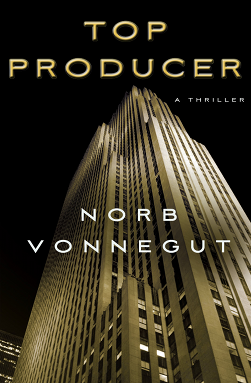
Top Producer by Norb Vonnegut is a well written, interesting business thriller, and about three quarters of his readers on Amazon agree with me.

Top Producer by Norb VonnegutVonnegut employs the first-person point of view, as well as the financial jargon of a professional, to convincingly put the reader in the shoes of a successful stockbroker in Midtown Manhattan. Grove O’Rourke, Southern-born and Harvard-educated, works for an investment bank, a place where “the elite go to get ideas and leave their money.” He handles approximately two billion dollars, and being a “top producer,” consistently delivers good returns.

Vonnegut’s first-person writing paints a vivid picture of O’Rourke’s pressure cooker of a life. In addition to acquiring and retaining clients, investing their assets, and “holding their hands,” he must cope with constant backbiting, manipulation, and game playing by colleagues and competitors who connive to steal his business.

The conceit of the novel is as follows: Grove’s closest friend, universally liked Charlie Keleman, is a flamboyant, free-spending manager of a boutique bank that invests in “funds of funds.” Charlie organizes a birthday party for his wife Samantha at an aquarium. During the belly dancer’s routine, and with five hundred guests looking on, someone pushes Charlie into the fish tank, where he is eaten by the resident sharks. Shortly after the tragedy, Samantha contacts Grove and informs him that she needs his help to locate Charlie’s money—she was not involved in the business; she has no idea where he parked their personal or business assets; and she has only $600 in her bank account.

So, the reader is now confronted with two questions:

  1. Who threw Charlie into the tank and why?
  2. Where is the money?

Grove insists on lending Samantha $75,000 to help her through the crisis, an action that will ultimately make him a “person of interest” when the detectives start their investigation. And he agrees to help her extricate herself from the financial morass. Vonnegut follows Grove as he attempts to unwind the two mysteries, cope with the detectives assigned to the case, and face both the revealed and unrevealed villains who are determined to keep the mysteries unsolved—all while attempting to preserve his lucrative investment practice and fight off his so-called colleagues who are “smelling blood in the water.”

The novel has two weaknesses, one minor, and one major.

  1. Vonnegut introduces some over-the-top minor characters who come across as almost cartoonish. Also, Grove’s occasional aphorisms spoken to the reader (Woody Allen–like) periodically interrupt the fictive dream.
  2. In light of his education and experience, Grove’s willingness to assume the dual roles of forensic accountant and private detective to solve the twin mysteries, while trying to preserve his businesses and not run afoul of the law, requires a whopping dose of suspension of disbelief.

Nevertheless, the novel’s strengths more than make up for its weaknesses:

    1. In Grove O’Rouke, Vonnegut has created a strong character who is truly a nice guy. His efforts to help Charlie’s wife resolve the mess that she is in, while often amateurish, are laudable. It is easy for the reader to identify with and root for him.
    2. A reader who is motivated to learn something about the nuts and bolts of high finance and security trading will be amply rewarded.

Review: Company Man by Joseph Finder

If you were to look up Company Man by Joseph Finder on Goodreads.com, you would not have to scroll far before seeing a review written in all capital letters. “FULL OF IMPLAUSIBILITIES,” this review screams, and although I’ll limit my complaints to lowercase letters–I’d have to agree.

Company Man follows Nick Conover, the CEO of a major corporation, as well as homicide detective Audrey Rhimes. This book is not low on conflict.  Nick Conover has 99 problems, among them: a dead wife, a company-wide conspiracy and a stalker who likes to spray-paint messages on and in Nick’s house.

Now, all of that is well and good. Finder does a thorough job of defining characters. He does a thorough job of developing problems. He is a ping-pong master when it comes to tracing conspiracies back to the source. However, none of that matters because this book’s foundation is made out of dominoes. The majority of those intricately designed problems are present and work because Nick Conover got a security system, equipped with cameras, at a specific time. Here’s the thing: it is simply not possible for the reader to accept that it took Nick’s house being broken into five times and his dog being murdered before he finally decided he needed a security system. Gated community or no, any sane person is getting that security system after the first break-in. Come on, Nick, your kids live there!

Company Man had other problems as well; existing separately, they might have been overlooked as simply bad decisions, but since they all happen in the same book, they stand out–like so many sore thumbs. Finder also has a habit of going into extreme detail for things that are not necessarily important. I specifically remember a bit about the “Workplace of the Future.”  It went on for a while, and I found it interesting, but after it had finished and moved on, I was left wondering what the point of it had been.

A clue to the prevalence of a lot of superfluous information is found in the four page “Acknowledgement” section at the end of the book. While the majority of fiction writers feel an obligation to thank their editor, publicist, graphic designer, publisher and perhaps their parents, Finder acknowledges the contribution of (approximately) 25 businesses/organizations and 80 individuals. The net result of all of these contributions is Finder winds up with an immense amount of information, most of which is not essential to carry the story; and too much of it finds its way into the novel – which cannot help but distract and/or confuse the reader and slow down the story.

All that being said, Company Man was a good thriller on bad foundation. It had twists that I didn’t see coming (although I probably should have) and characters so thought-out that Finder knew the names of their third grade teachers, their entire work resumes and the brand of toothpaste they used. I wouldn’t discourage you from reading it; just know that you’ll spend the whole book thinking, “Why didn’t Nick get that security system after the first break-in???”